Market Summary
Executive Summary and Global Market Analysis
Military wearable refers to advanced wearable technologies, smart devices, and integrated soldier systems designed to enhance operational efficiency, communication, situational awareness, survivability, and combat effectiveness across modern defense operations. These wearable solutions are increasingly being integrated into military forces to support real-time battlefield communication, physiological monitoring, navigation, mission planning, intelligence gathering, and soldier protection. Military wearable technologies include smart textiles, wearable sensors, exoskeleton systems, head-mounted displays, body-worn cameras, wearable computers, and advanced communication devices deployed across land, naval, and air defense operations globally.
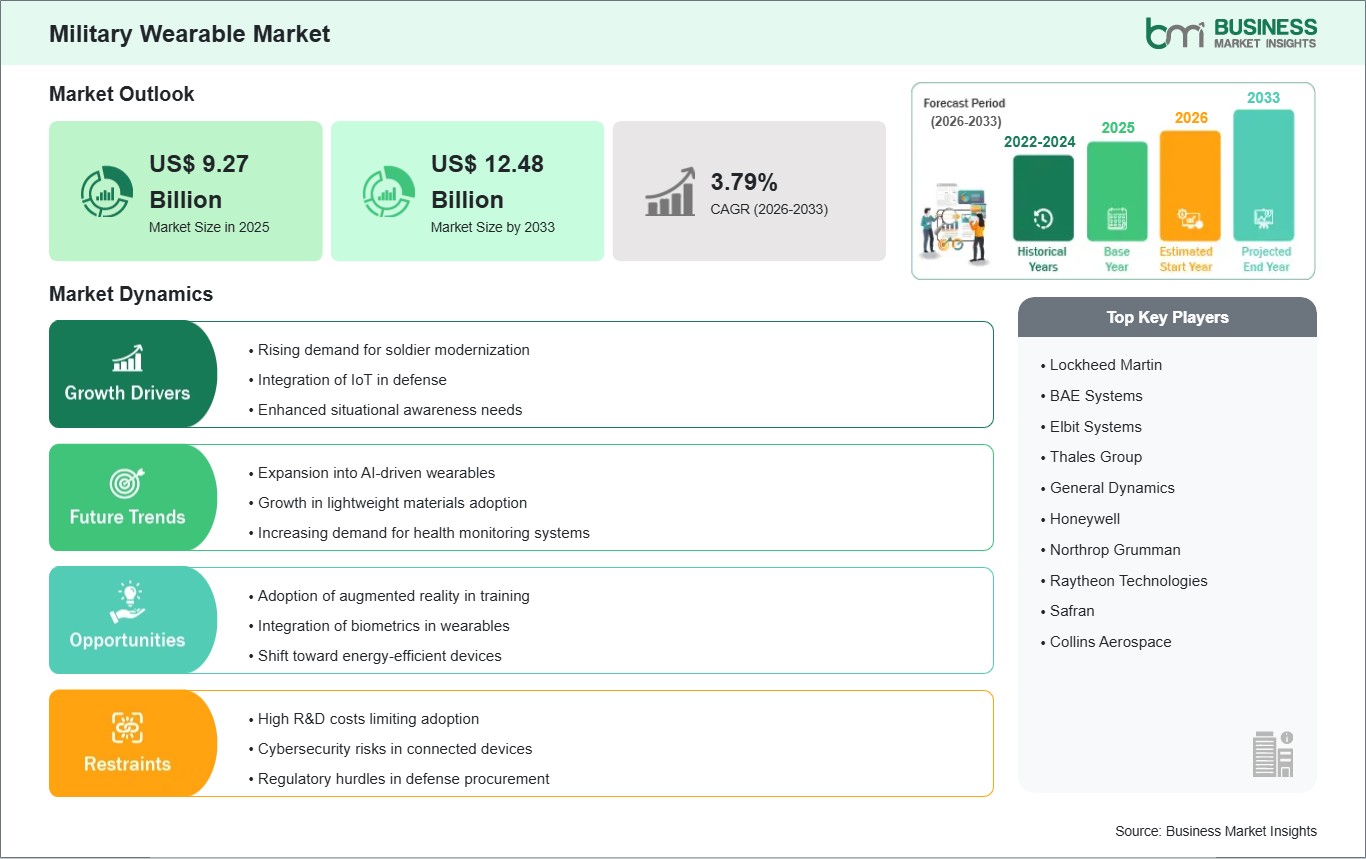
The market is witnessing significant growth due to increasing defense modernization programs, rising adoption of digital battlefield technologies, and growing emphasis on soldier modernization initiatives across global military organizations. Governments and defense agencies are investing heavily in wearable systems to improve operational efficiency, enhance troop safety, and strengthen real-time tactical coordination during combat and surveillance operations. The growing need for connected soldier systems, enhanced situational awareness, and integrated battlefield communication networks is accelerating the deployment of advanced wearable technologies across military platforms worldwide.
In addition, rapid advancements in artificial intelligence, augmented reality, smart sensors, IoT-enabled military devices, biometric monitoring technologies, and lightweight wearable materials are transforming the military wearable ecosystem. Defense organizations are increasingly integrating wearable computing systems, health monitoring sensors, tactical communication devices, and augmented reality-enabled head-mounted displays to improve mission execution and battlefield intelligence capabilities. The increasing adoption of data-driven warfare strategies and network-centric defense systems is further strengthening demand for military wearable technologies globally.
However, the market faces several operational and technological challenges. Military wearable systems require high durability, cybersecurity protection, long battery life, interoperability across military communication systems, and reliable performance under harsh environmental and combat conditions. High development and procurement costs associated with advanced wearable systems, integration complexities, power management limitations, and data security concerns may restrain market growth. In addition, strict military compliance standards, extended defense procurement cycles, and operational testing requirements can create barriers for technology providers and defense manufacturers.
Despite these challenges, the market outlook remains highly positive due to increasing investments in soldier modernization programs, smart battlefield technologies, and defense digitization initiatives. Significant opportunities are emerging through the integration of AI-enabled wearable systems, smart combat uniforms, real-time biometric monitoring, autonomous exoskeleton technologies, and next-generation augmented reality interfaces. The growing focus on tactical mobility, mission effectiveness, remote battlefield coordination, and soldier survivability is expected to create sustained long-term demand for military wearable solutions globally. Furthermore, increasing investments in future soldier programs, connected defense ecosystems, and integrated tactical communication platforms are strengthening the strategic importance of wearable technologies across modern military operations.
Segment Analysis
Military Wearable Market Segmentation
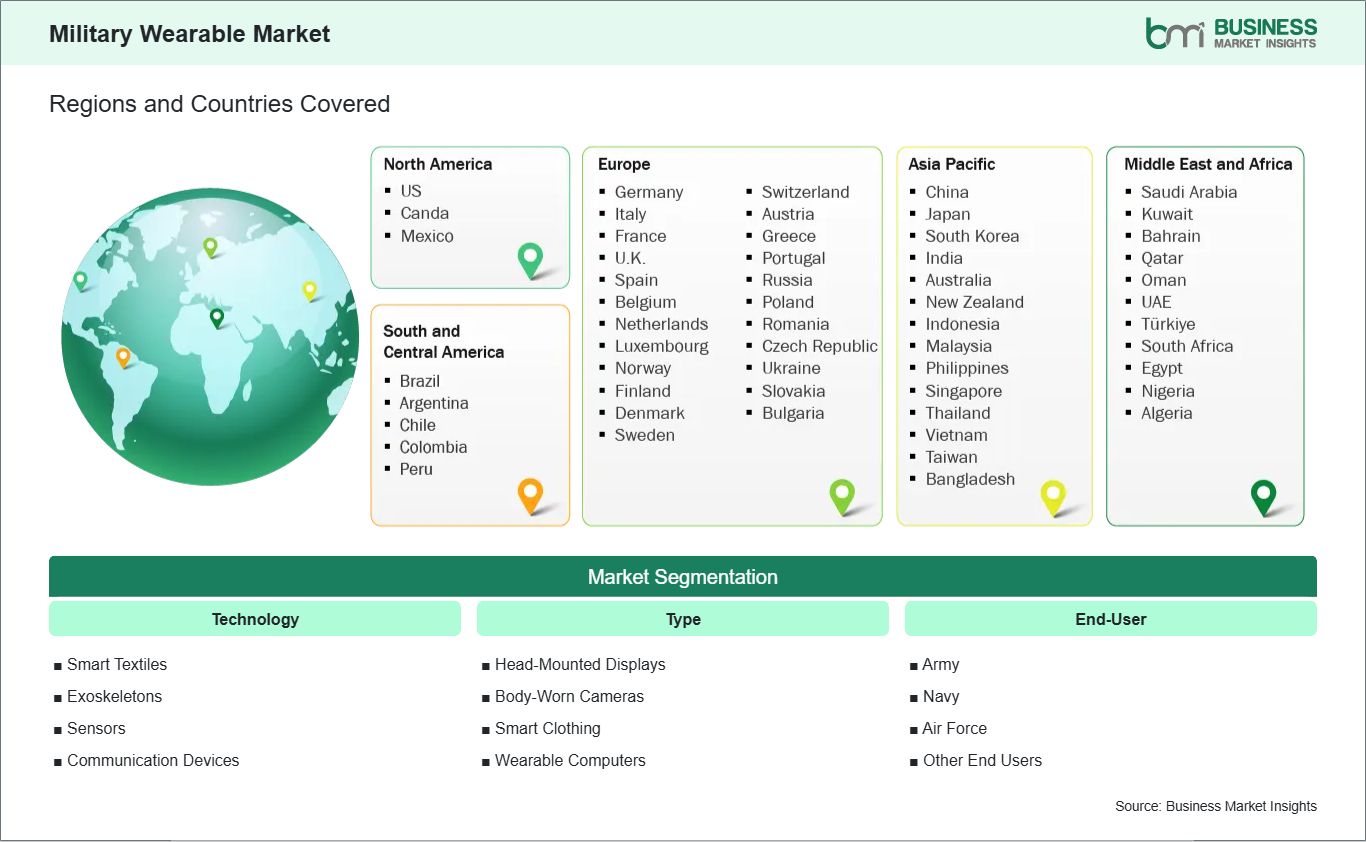
The military wearable market is segmented based on technology, type, and end user, reflecting the increasing integration of advanced wearable systems into modern defense operations and soldier modernization programs.
By Technology
- Smart Textiles: Advanced military fabrics integrated with sensors, biometric monitoring systems, temperature regulation technologies, and communication capabilities to improve soldier safety, comfort, and operational performance
- Exoskeletons: Wearable robotic support systems designed to enhance soldier mobility, physical endurance, load-carrying capacity, and combat efficiency during military operations
- Sensors: Wearable sensing technologies supporting health monitoring, physiological tracking, environmental detection, motion sensing, and real-time battlefield awareness applications
- Communication Devices: Tactical wearable communication systems enabling secure real-time voice, video, and data exchange across military command and battlefield networks
By Type
- Head-Mounted Displays: Wearable visual systems offering augmented reality interfaces, tactical navigation, mission intelligence, targeting assistance, and real-time situational awareness for military personnel
- Body-Worn Cameras: Wearable surveillance and recording devices supporting mission documentation, intelligence collection, law enforcement operations, and operational transparency
- Smart Clothing: Intelligent military apparel integrated with sensors, communication technologies, physiological monitoring systems, and environmental protection capabilities
- Wearable Computers: Portable computing systems integrated into military uniforms or gear to support tactical data processing, mission planning, battlefield communication, and operational coordination
By End User
- Army: Wearable technologies supporting infantry modernization, tactical communication, battlefield awareness, health monitoring, and combat effectiveness enhancement for land-based military forces
- Navy: Military wearable systems used in naval operations for communication, mission coordination, navigation support, diver monitoring, and maritime security applications
- Air Force: Wearable devices supporting pilot assistance, flight monitoring, augmented reality navigation, physiological tracking, and air combat mission coordination
- Other End Users: Includes special operations forces, border security agencies, homeland security organizations, and peacekeeping units utilizing wearable defense technologies for tactical operations and surveillance missions
Market Forces
Military Wearable Market Drivers and Opportunities
Rising Adoption of Soldier Modernization Programs and Connected Battlefield Technologies
The military wearable market is experiencing substantial growth due to increasing investments in soldier modernization programs and digital battlefield transformation initiatives across defense organizations globally. Modern military forces are prioritizing the deployment of advanced wearable systems to enhance situational awareness, improve communication efficiency, strengthen mission coordination, and increase troop survivability in complex combat environments. Wearable technologies are increasingly becoming essential components of future soldier systems and integrated defense communication networks.
The growing adoption of network-centric warfare strategies, real-time battlefield intelligence systems, and AI-powered tactical platforms is accelerating demand for smart wearable solutions across military applications. Governments worldwide are investing heavily in advanced combat gear, smart helmets, wearable communication devices, and physiological monitoring systems to improve soldier performance and operational readiness. In addition, increasing focus on multi-domain warfare, rapid tactical response capabilities, and mission-critical data sharing is creating strong demand for integrated wearable defense technologies.
Expansion of Smart Wearable Technologies and AI-Enabled Defense Systems
Significant opportunities are emerging in the military wearable market through advancements in artificial intelligence, augmented reality, smart sensors, and wearable computing technologies. Defense organizations are increasingly integrating AI-enabled biometric monitoring systems, real-time health analytics, exoskeleton support systems, and augmented reality headsets to improve mission execution and battlefield efficiency. These technologies support enhanced tactical decision-making, soldier safety monitoring, and operational coordination across combat and surveillance missions.
The growing development of lightweight wearable materials, energy-efficient batteries, secure communication systems, and IoT-enabled military devices is creating new growth opportunities for defense contractors and wearable technology providers. Furthermore, increasing investments in smart combat uniforms, integrated tactical displays, remote medical monitoring systems, and autonomous wearable support platforms are supporting the expansion of next-generation military wearable ecosystems. Vendors offering advanced wearable communication networks, AI-powered mission systems, and integrated soldier modernization platforms are expected to gain a competitive advantage as defense organizations continue to prioritize connected battlefield capabilities globally.
Size and Share Analysis
Military Wearable Market Size and Share Analysis
The Military Wearable Market is projected to grow from US$ 9.27 Billion in 2025 to US$ 12.48 Billion by 2033 , registering a CAGR of 3.79% from 2026 to 2033.
By technology, communication devices account for a significant market share due to increasing demand for secure battlefield communication, real-time tactical coordination, and connected soldier systems. Sensors and smart textiles are witnessing strong growth driven by rising adoption of biometric monitoring, physiological tracking, and intelligent combat apparel across military operations. Exoskeleton technologies are also gaining traction due to increasing focus on soldier mobility enhancement and physical endurance support.
By type, head-mounted displays hold a substantial market share owing to rising deployment of augmented reality systems, tactical visualization technologies, and mission intelligence platforms. Smart clothing and wearable computers are experiencing increasing demand due to advancements in integrated defense electronics and battlefield connectivity solutions. Body-worn cameras continue to witness strong adoption for surveillance, mission recording, and operational accountability applications.
By end user, the army segment dominates the market due to extensive deployment of wearable communication systems, smart combat gear, and battlefield monitoring technologies across land warfare operations. Air forces are increasingly adopting wearable pilot support systems and physiological monitoring devices, while naval forces continue to invest in maritime wearable communication and mission coordination technologies. Other end users, including special operations units and homeland security agencies, are also contributing to growing market demand for tactical wearable systems.
Report Coverage
Military Wearable Market Report Coverage and Deliverables
The "Military Wearable market Size and Forecast (2022–2033)" report provides a detailed analysis of the market covering below areas:
- Military wearable market size and forecast at global, regional, and country levels for all market segments covered under the scope
- Military wearable market trends, as well as drivers, restraints, and opportunities
- Military wearable market analysis covering key trends, global and regional framework, major players, regulations, and recent developments
- Industry landscape and competition analysis covering market concentration, heat map analysis, prominent players, and recent developments for the military wearable market
- Detailed company profiles, including SWOT analysis
Geographic Insights
Military Wearable Market Geographic Insights
The military wearable market demonstrates diverse regional adoption patterns influenced by defense modernization strategies, soldier modernization programs, and increasing investments in connected battlefield technologies.
North America holds a dominant position in the market due to high defense spending, advanced military technology infrastructure, and strong adoption of soldier modernization initiatives. The United States continues to invest heavily in wearable communication systems, augmented reality-enabled combat platforms, physiological monitoring technologies, and AI-based tactical support systems. Increasing focus on future soldier programs, integrated battlefield communication, and operational readiness is further supporting market growth across the region. Canada is also strengthening investments in wearable defense systems, Arctic mission support technologies, and advanced military communication platforms to enhance defense preparedness.
Asia Pacific is witnessing substantial market growth driven by rising geopolitical tensions, increasing military modernization activities, and expanding indigenous defense manufacturing capabilities. Countries such as China, India, Japan, and South Korea are heavily investing in smart military wearables, tactical communication devices, wearable sensors, and battlefield digitization programs. The region is increasingly focusing on advanced soldier systems, real-time battlefield awareness technologies, and connected defense ecosystems to strengthen strategic military capabilities. Rising investments in future combat systems, border surveillance operations, and integrated military electronics are further accelerating market expansion across Asia Pacific.
Europe is also experiencing notable market growth due to increasing NATO defense spending, growing investments in future soldier modernization programs, and rising adoption of digital warfare technologies. Meanwhile, Middle East and Africa countries are strengthening military modernization initiatives and tactical communication capabilities, contributing to increasing demand for military wearable technologies across the region.
Industry Activity
Recent Developments
The military wearable market is evaluated by gathering qualitative and quantitative data post primary and secondary research, which includes important corporate publications, association data, and databases. A few of the key developments in the military wearable market are:
- In May 2026, Elbit Systems Ltd. announced that its U.S. subsidiary, Elbit Systems of America – Night Vision LLC (“Elbit Systems of America”), received a delivery order valued at approximately US$212 million, for the continued production of the Enhanced Night Vision Goggle - Binocular (ENVG-B) systems for the U.S. Army. Deliveries under the award will take place through 2028.
- In May 2025, Anduril's AI wearables launch brings Palmer Luckey and Mark Zuckerberg's relationship full circle. The devices, called EagleEye, will be available as helmets, visors, and glasses. It will feature a display that Anduril says can overlay information, like the locations of a user's teammates, onto their live battlefield surroundings, according to a press release. EagleEye will be powered by Lattice, Anduril's AI software platform.
Trust & Transparency
Research Methodology
The market analysis combines proprietary research with secondary data from government agencies, company disclosures, regulatory filings, industry databases and expert interviews. Market estimates are validated through data triangulation, cross-market benchmarking and analyst
review.
View Full Research Methodology
Key Sources Referred:
Stockholm International Peace Research Institute (SIPRI)
North Atlantic Treaty Organization (NATO)
International Institute for Strategic Studies (IISS)
S. Department of Defense (DoD)
Company Websites
Company Annual Reports
Company Investor Presentations